This will be a rambling, semi-incoherent post. It’s hard to put into words what I want to write, so I’ll get at it sideways: I’m turning my heartbreak into a playlist and talking about the songs (instead of talking about my feelings like a grown-up).
The period from Fall 2024 to Fall 2025 has been a year defined by heartbreak and healing, likes of which I’d never experienced before. I had to learn—at the juvenile age of forty-something—about co-dependency, limerence, and attachment theory. The lessons, unfortunately, weren’t theoretical but painfully applied.
This coincided with me listening to a lot of breakup songs. All of a sudden, I realized that so many of them are about unhealthy, insecure attachment. It brought to mind Tolstoy’s line, ‘All happy families are alike; each unhappy family is unhappy in its own way.’ I guess secure attachment just doesn’t create the same fireworks, either in the relationship or in the breakup. Finding so much kinship in these lyrics, I decided to write about my experience through them.
While there are many amazing songs, I find the album Stick Season (and the song that gave the album its name) from Noah Kahan consistently nails it. I spent the last year listening to that album a lot when I was alone. The fucking emotional terrorist that he is, he puts words to feelings you’d better keep to yourself, forcing you to leak them like a roadside restroom faucet.
If the song ‘Stick Season’ comes up on your playlist in public, you have exactly 17 seconds to shut it down before it hits you. I mean, just read these lyrics for a second. After the first verse, you’re already in deep. We already established you were dumped when you were expecting to have a future (“kept on driving straight, left our future to the right”). The second verse digs a deeper hole to put you in… You’re stuck between your anger and the blame you can’t face… And the fucking dark, rainy autumn days are not helping you any, ’cause it triggers memories (“terrified of weather, ’cause I see you when it rains”).
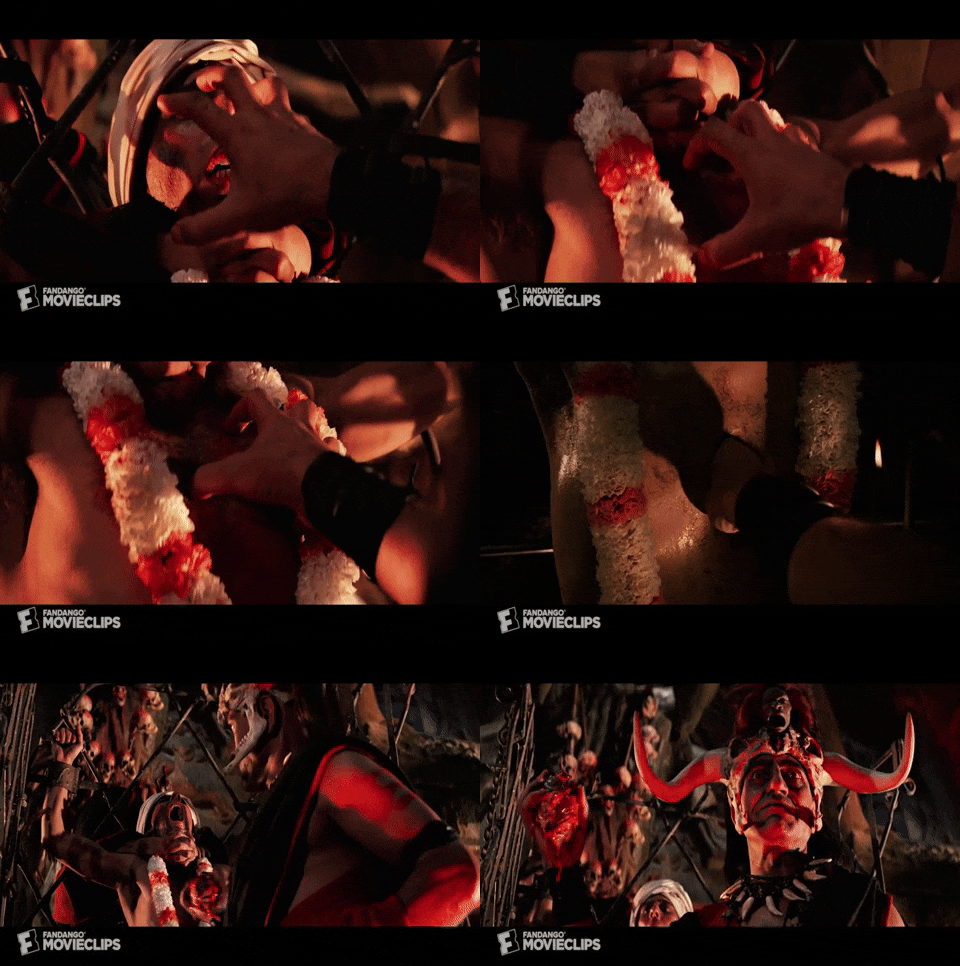
Is there a word in this song that doesn’t connect with a person with a tendency for co-dependency? He even points to losing your own personality: “No, I am no longer funny, ’cause I miss the way you laugh.” It just keeps hitting you where it hurts. That bargaining with a past you can’t change? “And I’ll dream each night of some version of you / That I might not have, but I did not lose.” The feeling of being fundamentally broken? “And I’m split in half, but that’ll have to do.” The hits just keep coming. ‘Stick Season’ is like the human sacrifice scene from Indiana Jones and the Temple of Doom. Noah takes your beating heart from your chest and shows it to you as you watch. All the pain you thought was unique to you is put to words, given a good tune, and played back to you in stereo!
‘All My Love’ is laying out the map of a relationship that ended with a lot of love still in it. When he says, “now I know your name, but not who you are,” he means you thought you knew this person, but the breakup shook your conception of who they were and what you are to one another. Now you know a lot about them but can’t seem to recognize them after all the pain. He goes on to say, “There ain’t a bit of bad blood,” which hits home for when you lived a version of the relationship in your head, where everything was alright (detached from reality), and now you look back and can’t find a single speck of blame to go their way…
‘Growing Sideways’ is about the dynamics that lead to unhealthy relationships. When he says, “But I ignore things, and I move sideways / Until I forget what I felt in the first place,” he’s describing the textbook anxious-attachment-in-action. It’s that fear of voicing your concerns, so you swallow them to preserve a painful connection. The cost of this self-abandonment is high: “I’m terrified that I might never have met me”. You get so good at running on fumes for someone else that you start to believe your “engine works perfect on empty.” It is choosing numbness over the potential pain of truth, and it’s a direct line to the kind of heartache that defines codependency.
The rest of the album isn’t helping you much in keeping your composure in the office, either. When he talks about being denied heaven in her eyes in ‘She Calls Me Back.’ Or in ‘Everywhere, Everything,’ wishing for holding hands until fingers decompose… I think Noah Kahan can retire to some remote island now that he’s achieved his mission of reminding us how miserable we are. Still, I think all in all, Noah Kahan is not only singing about heartbreak and the destruction in its aftermath. It is a deep reflection on the journey to healing as well.
You are probably thinking “So is this post just about one album? I thought it was about breakup songs?” I don’t think anyone matches Noah Kahan in the understated and complete manner he destroys my heart, but there are a few worthy mentions.
Hold On To, by Angus and Julia Stone as featured in Life is Strange: True Colors… The whole song is written for when you have a lot of love to give, but the relationship can not go on anymore. When she sings: “How do I say, I love you the day I let you go” you can’t help but remember that little garden in the back of that hospital you saw her for the last time. She says “I won’t hold on to, this place without you” and you remember going back to the home, and seeing every little mark she left in your life. I think the song generally has a trajectory towards healing. It’s a song focused on survival, asking, “How do I change / All of the pain into the joy?” and showing you that saying “I will say goodbye” is the first step.
Billie Eilish’s Birds of a Feather is also a riff on similar themes, but where in Kahan, and Stones codependence is implied, Billie Eilish aggresively declares it. Billie Eilish also doesn’t seem to give two shits about healing as she says: “If you go, I’m goin’ too” and “Nothin’ left to lose without my baby.” Rather than healing after separation Billie Eilish would rather go down with the ship: “Till I’m in the grave / Till I rot away, dead and buried / ‘Til I’m in the casket you carry.” The lack of maturity here is bothersome to me now. I value the emphasis on healing and moving on.
I guess that is also where I am now. I’m moving past the temptation to “go down with the ship” and instead, focusing on the hard work of cultivating self-compassion. The greatest lesson this whole miserable year taught me is that every anxious habit and every moment of unhealthy attachment was ultimately a misguided attempt to avoid pain. The soundtrack of my life is shifting. Now, I’m simply committed to identifying, accepting, and healing the parts of me that are still split in half.
 Irfmeister's Adventures
Leave a comment