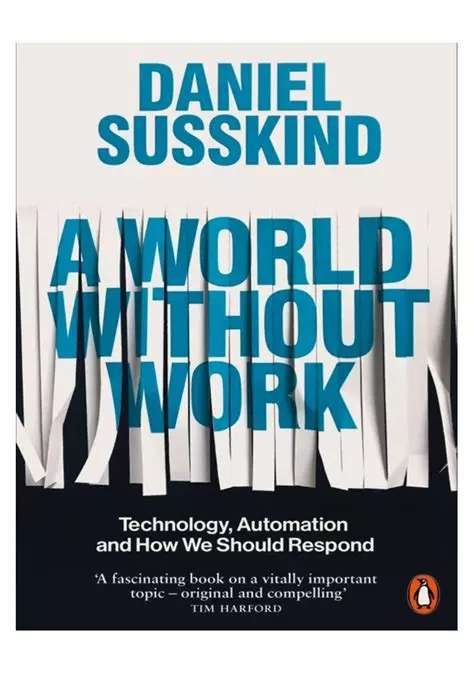
A World Without Work – Susskind
I recently finished reading A World Without Work. In the times we are living in, it hit differently than what I had read on the topic beforehand. Technology’s role in labor and employment has been an interest of mine for a while. I have even published in the field. I will try to keep my inner academic on a leash and avoid turning this post into a literature review, though I do want to reflect on where the book sits in the broader conversation.
Looking back at my prior reads, I thought Brynjolfsson and McAfee’s The Second Machine Age was overly optimistic in pushing the idea of “centaurs,” or human-machine amalgams outcompeting machines. To me, that always seemed like a short-lived solution, a kind of “god of the gaps” argument surviving in ever-shrinking niches. I found myself more drawn to the “way of the horses” argument in Martin Ford’s Rise of the Robots: human labor disappearing just like horse labor did when better technology outcompeted it.
The central question in this field is whether technology will create more jobs than it destroys. Susskind’s work is interesting because he breaks down the mechanism behind both forces, showing how complementary and substitutive pressures pull in opposite directions, and how their relative strength determines whether we end up with new jobs elsewhere in the economy or a net loss. Like Ford, Susskind argues that with AI we may be facing a far more substitutive technology, one where a lot of jobs simply disappear.
Even if mass unemployment is averted, Susskind argues, the nature of this technology shifts the balance of power toward capital. It reminded me of Piketty’s observation that the return on capital outpaces the return on labor. Susskind’s point is similar: as technology displaces workers, labor’s share of economic growth shrinks in favor of capital. That dynamic pushes inequality, both in the economic equation and in society, even further, accelerating the concentration of wealth.
With concentration of wealth comes political power. The part of the book I found most refreshing was when Susskind stepped outside his home discipline of economics to examine the political implications of that concentration. Anyone who saw Trump’s second inauguration and the line of tech billionaires standing behind him saw this firsthand – to say nothing of Elon Musk taking a chainsaw to the government, or Trump intervening on behalf of Jensen Huang. It is increasingly obvious that there is a class of people no longer bound by the same rules as the rest of us.
Where Susskind lost me a bit was in his broad generalizations and failure to seriously engage with socialist theory. He conflates several distinct left-wing positions and lumps them together for easy critique, essentially building a strawman. I just found it to be lazy argumentation, and he might have been better off leaving that half-hearted analysis out altogether.
On policy, Susskind argues for a big state to create jobs, redistribute wealth, and provide meaning. The economic proposals, like universal basic income, are familiar territory. What stood out to me was seeing an economist engage seriously with the loss of meaning in people’s lives. He goes further than Ford’s suggestion to simply disconnect our self-worth from work, offering concrete policy ideas to address the void.
The book kept me hooked throughout. I found myself reading further than I intended every time I picked it up. Like I said, it hit differently this time. When I read Ford, Brynjolfsson, and McAfee years ago, it felt like we were talking about a distant future. Now that future is here. AI is changing work today, and I increasingly believe that shift is independent of the hype cycle or any financial bubble.
There is no doubt in my mind about the unrealistic expectations or the financial shenanigans propping up tech stocks. Still, those things aren’t mutually exclusive with real disruption. The AI bubble may burst, and we may still end up with entry-level jobs permanently cut. Companies that laid off engineers may have overreacted to the current tools, but that doesn’t mean a far more capable version won’t arrive two years down the line.
It is time we start making plans beyond packing up and moving to the countryside. We need plans that require our governments to think seriously about what happens to their citizens in a world where human labor is no longer in demand.